M.Sc. Prima Sanjaya defends the doctoral thesis "Interpretable deep representation learning of somatic mutations for tumour classification and risk stratification" on 16 October 2026 at 13.00 in Biomedicum 1, Lecture hall 2. Professor Matti Nykter, Tampere University, serves as the opponent.
Alireza Tajmirriahi starts as a doctoral researcher in the FIMM-EMBL rotation program, combining histopathology foundation models with paired spatial transcriptomics data. Welcome!
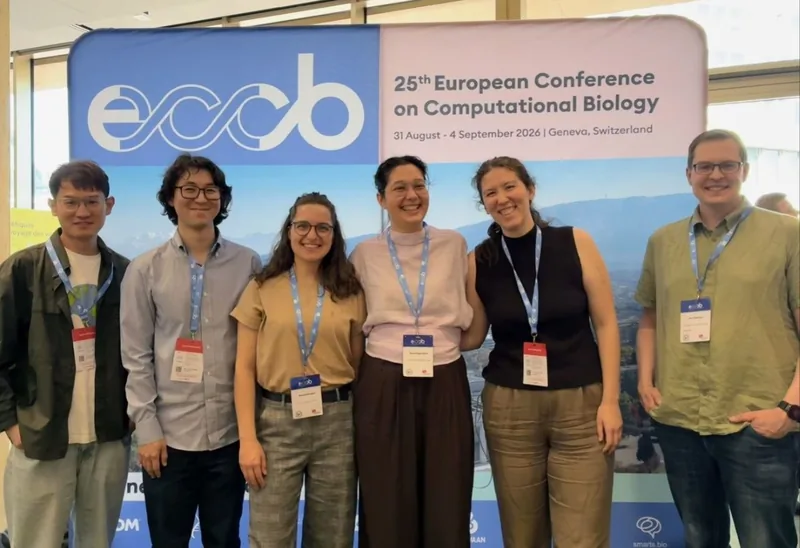
Guangzhao, Daniyar, Nora, Arina and Hanna presented posters at the 25th European Conference on Computational Biology, Geneva, 31 August - 4 September 2026.
Guangzhao, Daniyar, Nora, Arina, Hanna and Esa at ECCB 2026, Geneva Photo: Kira Detrois
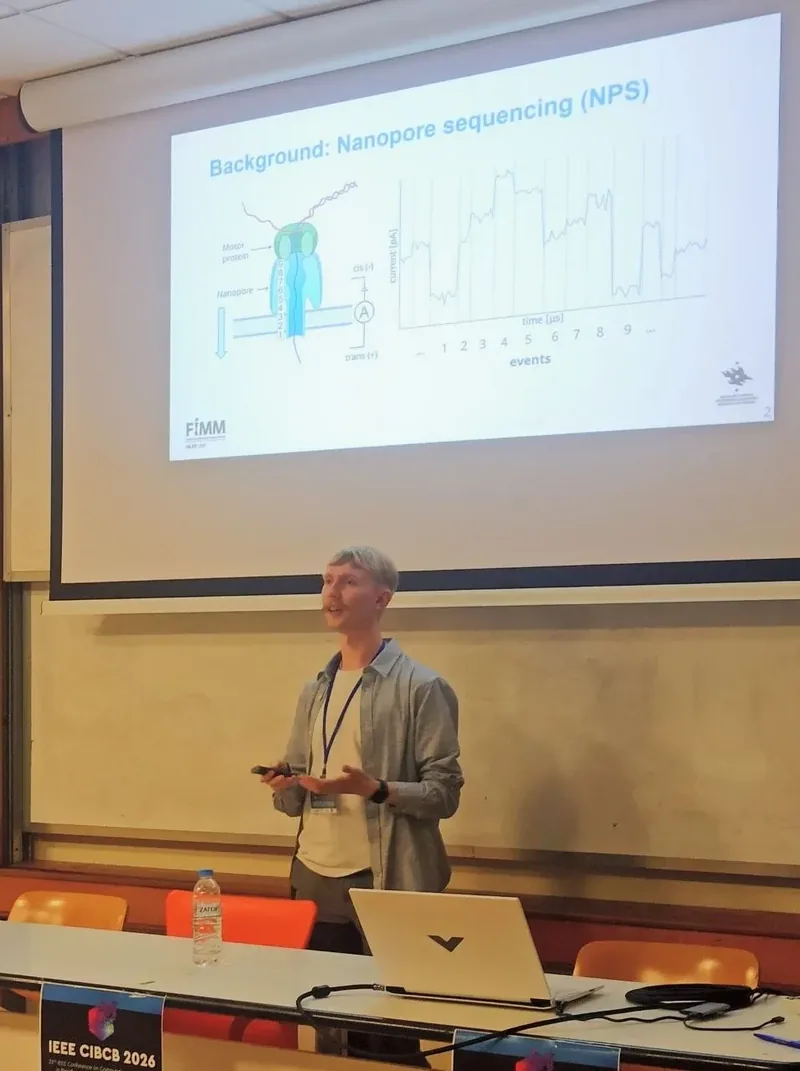
Yrjö presented NanoDS, accurate simulation of nanopore sequencing data with distribution approximations, at the IEEE Conference on Computational Intelligence in Bioinformatics and Computational Biology, Athens, 31 August - 2 September 2026.
A foundation model pre-trained on 48 million prostate tissue tiles outperforms natural-image pre-training and improves prostate cancer survival models when combined with clinical nomograms.
Noora Hautamäki finishes as a research assistant after six months with the group. We wish her best of luck in her doctoral studies at the University of Arizona!
Single-cell transcriptomics of patient marrow finds ferroptotic erythroid stress arising before TP53 mutation in both ERCC6L2 disease and Shwachman-Diamond syndrome.
The MuAt models packaged for Docker and Bioconda, reproducing published accuracy and reaching 81% in the Genomics England secure environment without retraining.
MuAt2 classifies tumour type and subtype jointly across 14,527 Genomics England whole genomes, with embeddings that stratify glioma prognosis and infer origins of unknown primaries.
A variational autoencoder over 3,110 amyloid PET scans separates four subgroups along the Alzheimer's continuum without preset positivity thresholds, two of them progressing faster.
Y. Koski, Patel, Kakko von Koch, Jouhten, Aaltonen, Palin#, Sahu#, Pitkänen#
bioRxiv
A statistical toolkit for nanopore signal that separates four adduct-inducing compounds by their effects on base quality, ionic current and translocation dynamics.
Pipeline for evaluating coding germline variants at cohort scale, used to find rare alleles enriched in hematological patients of the Finnish founder population.
A digital pathology foundation model trained on prostate cancer tissue, with encoders you can drop into your own downstream task instead of training from scratch.
Analysis code for the HemaSphere paper: single-cell RNA sequencing of bone marrow in ERCC6L2 disease and Shwachman-Diamond syndrome, from preprocessing to the stem cell identities and the shared erythroid stress signature.
Portable transformer that reads a patient's somatic variants and returns tumor type, subtype and a learned representation. Available as a conda package.
Lei Xia starts as a postdoctoral researcher on a joint Nordic EMBL Partnership appointment with the Biswajyoti Sahu group at NCMBM, University of Oslo. He works on the regulatory logic of cancer genes with nanopore sequencing.
Reference implementation of Mutation-Attention: deep representation learning of somatic mutations for tumour typing and subtyping, as published in Genome Medicine.
J. Koski, Langohr, Räisänen, Lahtinen, Hakkarainen, Heckman, Wartiovaara-Kautto#, Pitkänen#, Kilpivaara#
medRxiv
An ACMG-guided pipeline over 511 Finnish hematological malignancy patients finds CHEK2 variants enriched 1.7-fold and candidate alleles in CUX2, RNPC3 and MFSD2A.
A residual network predicts cerebrospinal fluid amyloid-beta directly from amyloid PET scans (r = 0.92), without preselected reference regions or tracer-specific thresholds.
Ji, Li, Sun, Dong, Taalas, Zhang, Wu, Pitkänen, Marttinen
ACM Computing Surveys
A review that decomposes deep learning models for medical coding into encoder, architecture, decoder and auxiliary-information components, with benchmarks and open challenges.
Strong augmentation for training histopathology models that hold up on slides from other scanners, stains and laboratories, as measured in the fragility study.
Generates fluorescent-channel images from brightfield imaging flow cytometry, allowing blood cell phenotypes to be read without staining every channel.
Sanjaya, Maljanen, Katainen, Waszak, Genomics England Research Consortium, Aaltonen, Stegle, Korbel, Pitkänen
Genome Medicine 15:47
Attention over individual somatic mutations types tumours from whole genomes at 89% accuracy and recovers subtypes that were never given as training labels.
Timonen, Kerkelä, Impola, Penna, Partanen, Kilpivaara, Arvas, Pitkänen
Cytometry Part A
An Inception U-Net generates fluorescent marker images from brightfield imaging flow cytometry, typing blood cells without staining, including types unseen during training.
A review of cell-free DNA fragmentomics in B-cell lymphoma liquid biopsy: how fragment patterns form, the technical limits, and where machine learning fits.
Distribution-shifted datasets expose generalisation failures that validation against external cohorts misses, and strong augmentation trains models that hold performance under those shifts.
Regularising prediction scores with spectral decoupling counters overfitting to easy features and adds up to 9.5 percentage points on external medical imaging datasets.
Interactive browser for finding causative variants in coding and noncoding genome, combining data integration, comparison and visualization in one view. BasePlayer 2, an enhanced version of BasePlayer, is currently in development and will natively support multimodal data, including long-read and methylation sequencing.
The ICGC/TCGA Pan-Cancer Analysis of Whole Genomes Consortium
Nature 578, 82–93
Integrative analysis of 2,658 whole cancer genomes across 38 tumour types, covering driver mutations, chromothripsis, telomere maintenance and germline effects on somatic mutation.